Gas Prices Got You Down? Try Vanpooling!

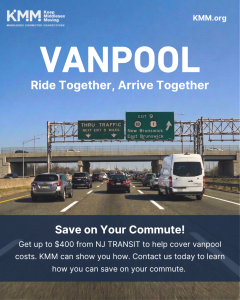
If you’ve ever considered vanpooling, now is the time! In Jauary 2026, NJ Transit’s Vanpool Sponsorship Program increased from $175 to $400 per month for all eligible vanpools. Space in the program is limited so don’t miss your chance to save big!*

Why Vanpool?

Vanpooling provides a host of benefits for commuters and employers alike. (Numbers below are based on a 2023 report from Commute with Enterprise).

Save Money

· Between gas, maintenance, repairs, and insurance – Commuting alone can be expensive. In 2024, the average vanpool participant with Enterprise saved $10,000 (Commute with Enterprise). Enter your specific commute details and see how much you can save with the Commute with Enterprise calculator.

Less Stress, More Time

· Let’s face it – Driving can be stressful! Share the burden and allow yourself more time to read, get some work done, or just relax!

Sustainability

· Sharing your commute means less traffic on our roads and less harmful emissions in our air! Companies vanpooling with Enterprise eliminate 1.2 billion commuter miles and reduce emissions equal to 492,000 acres of US forest annually.

Employers: Attract Talent and Retain Employees

· Quality of commute is a critical element for employee satisfaction! Vanpooling can help you a retain happier, healthier, and more productive workforce.

Ready to Give Vanpooling a Try?

Keep Middlesex Moving can help you through the process! Here’s how it works:

  1. Vanpools consist of 4-15 individuals who regularly commute to work.
  2. Vehicles are available via NJ Transit approved third-party provider, Enterprise. Since leases are only on a month-to-month basis, commitment is minimal.
  3. Third-party vendors cover all maintenance and repairs. Van rental and gas are your only costs!
  4. KMM will support new vanpools with a $125 empty seat subsidy for the first three months. If one of your vanpool commuters can no longer vanpool with your group, KMM can offer a $125 “Empty Seat” subsidy to eligible vanpools. Additionally, KMM’s “Emergency Ride Home” program reimburses up to $50 per trip, up to three times per year, when you unexpectedly can’t take your regularly scheduled vanpool home.
  5. Driving responsibilities and cost sharing arrangements are decided by each vanpool group independently.
  6. Keep Middlesex Moving will assist you in applying for the NJ Transit Vanpool Sponsorship program, as well as establishing your vanpool’s operating procedures.

With the NJ Transit Vanpool Sponsorship now more than double in value, there has never been a better time to start a vanpool. The staff at Keep Middlesex Moving is here to walk you through the application process and support you every step of the way! If you work in Middlesex County and are ready for a smarter commute, contact Connor Wallace, cwallace at kmm.org or (732) 745-4465 ext. 106, to learn more!

Learn more about Commute with Enterprise here

*Disclaimer – This new NJ TRANSIT sponsorship will cover all 68 current vanpools and to 83 vanpools on a first-come, first-served basis.

Are You Ready for the 2026 World Cup?

In about a month, millions of visitors will be heading to World Cup games in Philadelphia and New Jersey. The games are expected to generate significant traffic congestion and delays during matches in June and July. Matches will take place in East Rutherford (NYNJ Stadium) and Philadelphia (Philadelphia Field) from June 11 through July 19. In addition, “Fan Festivals” will be hosted in Harrison (at Sports Illustrated Stadium) and Philadelphia (at Lemon Hill).
Here in Middlesex County, New Brunswick will host the Senegal National Team. To help reduce congestion as much as possible and avoid getting stuck in traffic, NJDOT is strongly encouraging area companies and employees to: 

  • Work remotely when possible.
  • Adjust work start and end times.
  • Stagger shifts to avoid travel between 5 hours before and after kickoff.
  • Refrain from scheduling in-person meetings on match days unless necessary.
  • Carpool or vanpool by registering at www.njrideshare.com.
  • Check for travel alerts at 511nj.org.

You can find more information on match locations, dates, and times, at the links below:

Information on Fan Festivals can be found below:

Follow these tips to make your commute easier during the World Cup:

  • Skip it: Can it be done virtually? Skip the commute.
  • Shift it: Encourage off-peak travel. Shift to flexible hours or a compressed work week.
  • Switch it: Help ease congestion. Switch to remote work during scheduled games.
  • Share it: Carpool or vanpool to work. Visit www.njrideshare.com to find a carpool partner near you.


NJ TRANSIT has also created a website dedicated to assisting commuters, visitors, and residents navigate through the region during the world games. You can learn more by visiting www.njtworldcup.com.

Keep Middlesex Moving is your transportation resource in Middlesex County. Our team is here to assist commuters and organization facilitate carpool, vanpool, and work from home programs for the world’s games. For assistance, contact us today!


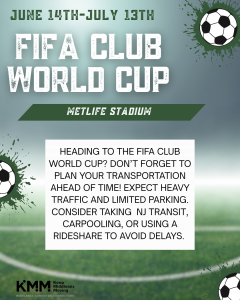
Plan Ahead for FIFA Club World Cup 2025TM!

The World’s Biggest Clubs. History is in the making! This summer, MetLife Stadium is proud to host matches for the FIFA Club World Cup 2025, a global tournament that brings together the best club teams from every continent, all competing for international glory. From group stage matchups to the epic final on July 13th, MetLife will be at the heart of the action.

For New Jersey residents, this means commuters may experience additional transit delays and higher than normal traffic on major roadways including the NJTP, Garden State Parkway, and other state and local roads. Here are some tips for those traveling to FIFA Club games, commuting to work, or traveling through the area for other reasons:

  1. Plan Ahead! Check match schedules at metlifestadium.com.
  2. Leave ample time to arrive at your destination, especially if you will be traveling to/near MetLife Stadium.
  3. Take public transit whenever possible.
  4. Consider working from home or adjusting your schedule if your employer allows.
  5. Register to find a carpool partner at njrideshare.com.

Whether you’re a lifelong soccer fan or new to the game, this is a chance to experience the passion, pride, and energy of the world’s most popular sport, live and in person. Tickets, match schedules, and transportation info can be found at metlifestadium.com. Plan ahead! Take the train, ride the bus, or rideshare to beat the traffic!

New Jersey will be the host city for the 2026 FIFA World Cup, where eight games, including the World Cup Final will be played. Learn more at NYNJFWC26.com.

What is Vision Zero?

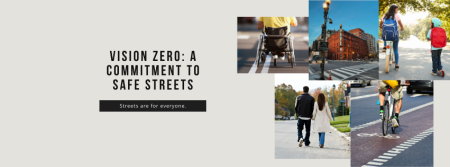
Vision Zero: A Commitment to Safe Streets and includes images of people walking, biking, scooting and using a wheelchair on roads.

You’ve probably heard a lot about Vision Zero and you’re wondering what is it? Municipalities across New Jersey and the United States are committing to Vision Zero through resolutions, ordinances aimed at increasing road safety, and street redesigns that accommodate all people, regardless of how they get around.

What is Vision Zero? A Bold Strategy for Road Safety

In the world of transportation and road safety, Vision Zero has emerged as a groundbreaking approach aimed at eliminating traffic-related fatalities and serious injuries. While the idea might seem idealistic at first, it’s grounded in the belief that no loss of life or serious injury on the roads is acceptable. By shifting the focus to proactive safety measures, Vision Zero aims to create a road system that protects all users, including drivers, pedestrians, cyclists, and motorcyclists.

Origins of Vision Zero

Vision Zero was first introduced in Sweden in 1997. The country, known for its strong commitment to social welfare and public safety, set out with the goal of creating a transportation system where nobody would be killed or seriously injured in road accidents. Since its inception, Sweden has seen significant success, with traffic fatalities dropping by over half in the years that followed the implementation of Vision Zero.

Seeing these positive results, the idea began to spread globally. Today, cities and countries around the world have adopted Vision Zero as part of their road safety strategies, including major urban centers in the U.S., Canada, Europe, and beyond. But Vision Zero isn’t just a set of guidelines—it’s a call to action and a comprehensive approach to how we think about traffic safety.

Key Principles of Vision Zero

  • Human-Centered Design: One of the core tenets of Vision Zero is the recognition that humans make mistakes. Road design should accommodate human error, making it difficult for accidents to result in serious injuries or deaths. For example, roundabouts or protected bike lanes can reduce the likelihood of fatal collisions.
  • Systemic Safety: Vision Zero doesn’t just focus on individual behavior but emphasizes improving the entire transportation system. This includes engineering safer roadways, introducing more robust vehicle safety standards, and enhancing traffic laws. The goal is to redesign roads and infrastructure to prevent severe accidents from occurring, regardless of human error.
  • Shared Responsibility: Unlike traditional road safety approaches, which often place the blame for accidents on drivers, Vision Zero emphasizes that responsibility is shared by everyone involved—drivers, cyclists, pedestrians, policymakers, and engineers. It’s not about blaming individuals but creating a safer system for all.
  • Data-Driven Solutions: Effective policies and infrastructure changes must be informed by solid data. Vision Zero calls for detailed data collection on traffic accidents, injury patterns, and the behavior of road users to determine where improvements are needed. This allows for targeted solutions and better resource allocation.

Vision Zero in Practice

While Vision Zero might sound like an ambitious ideal, there are numerous real-world examples showing its effectiveness. Cities around the world have already begun to implement Vision Zero strategies with significant success.

  • Hoboken, NJ: Since committing to Vision Zero in 2018, Hoboken has not seen a traffic fatality in seven years, thanks to safety improvements that include daylighting intersections – the process of increasing visibility at crosswalks, incorporating bike lanes, and reducing speed limits throughout the city.
  • Jersey City, NJ: Jersey City became the first city in New Jersey to commit to Vision Zero through initiatives like pop-up pedestrian plazas, installing roundabouts, reducing speed limits, and daylighting intersections.
  • New York City: In 2014, NYC adopted Vision Zero as part of its official traffic safety strategy. The city implemented measures like lower speed limits, the expansion of bike lanes, and increased enforcement of traffic laws.

As more cities adopt Vision Zero principles, it’s becoming clear that road safety is not just about enforcement but about rethinking the very nature of how we design and interact with our road systems. The initiative has the potential to transform cities into safer, more inclusive environments where everyone—from children to the elderly—can move around confidently without the constant threat of road crashes.

Vision Zero is A Shared Goal

Achieving zero traffic deaths and serious injuries requires continued collaboration among government agencies, engineers, public health professionals, and the public. Everyone must play a role in ensuring that Vision Zero is more than just a lofty goal but a tangible, life-saving reality.

Vision Zero is more than just a traffic safety program; it is a philosophy that redefines how we view road safety. It challenges the notion that traffic deaths are inevitable and calls for systemic changes to create a safer world for all road users. The journey toward zero is long, but it’s a step toward a future where no one has to fear for their life on the road.

Learn more about Vision Zero, download a sample resolution, and take the Vision Zero Pledge HERE.

Coronavirus: Implementing a Telecommute Contingency Plan

According to the CDC, Americans need to start preparing now for the possibility that more aggressive, disruptive measures might be needed to stop the spread of the new coronavirus in the U.S.; this includes the workforce.  It is recommended that companies put a contingency plan in place.  Here are some guidelines to help you create your contingency plan.

Responsibility – Sit with your staff and have them identify their day to day functions and what programs they use to perform these functions.  Understand the tools and software they use and determine whether there are any security risks associated with them working remotely.

Hours – Although a simple idea, it’s smart to establish the hours in which the employee will be working remotely.  It provides accountability and a sense of routine.

Technology – Establish the ways in which you and your team will accomplish their daily tasks. Do they have internet access, laptops and the correct software needed while working remotely?  Can their office phone calls be forwarded to the remote phone line?

Cost / Logistics – What are the costs involved in working remotely? Once you have determined what is needed to work from home, be sure to outline what costs – if any – you will reimburse your employees (i.e. internet, phone calls).

Communication – The key to a successful telecommute program is communication.  Establish a schedule of when your office team will meet remotely and establish the tools you will use.  Skype, GoToMyMeeting and FaceTime calls are all ways for everyone to meet remotely.  Programs such as Basecamp can be a helpful tool for those working on different components of a project.

Accountability- In instances where telecommute programs are in place as a benefit, reviews are often scheduled every three months to ensure deadlines have been met and the work-from-home program is working for both the employee and employer.  However, in an instance such as a temporary telecommute program due to a crisis, these telework situations may last a few weeks.  None the less, it would be prudent to set up calls between all levels of staff and support to assess everyone’s performance.

Tune in to Mobility Matters

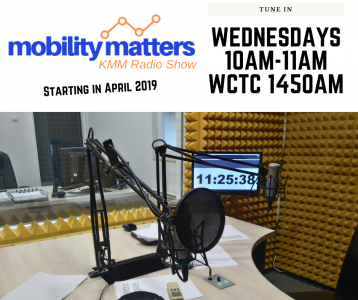
We are thrilled to share that KMM will be launching a radio show /podcast – Mobility Matters – on WCTC 1450 AM radio beginning in April 2019. Tune in on Wednesdays at 10 am. Join us as we talk to leading experts in the fields of transportation, sustainability, and economic development.

Love your Commute

Commuting can be one of those items that fall way down on the list of things you love to do.  And you are not alone.  The average travel time for working New Jerseyans is 31.2 minutes, which is almost seven minutes longer than the average US commute.  So what can we do to make your commute better?

Commute Smarter.  Sounds silly, right edlekarna.cz?   Before you click away, let us explain.

Our staff can help you find a commute that not only maximizes your time spent commuting but also do so in a way that is sustainable for both your wallet and the environment.  We manage a host of databases that can match you with a carpool or vanpool partner.  We can connect you with transit-friendly solutions and provide you with tools that make biking to work an option if that is something you think you would like.  We even have a free NJ Traffic app you can download and customize to your commute! And if all options are not available for you, we can recommend the best podcasts or apps to accompany you on your commute.

Don’t spend one more moment dreading your commute.  Let us help you love your commute.   Reach out to us.

We’d be happy to help!

Snow is the Forecast…

Although winter comes as no surprise, many of us are not ready for its arrival. Winter storms or other severe weather conditions can cause serious damage. This winter season it is important to think about winter weather approaching and most importantly to be prepared for it. Here are some tips to help you get through the cold this winter:



Prepare Yourself

  • Stay indoors during the storm.
  • Walk carefully and cautiously on snowy, icy walkways.
  • Stay dry. Wear winter essentials like a hat, gloves, scarf, and jacket as a way of protection against the cold.
  • Check your homes heating system. Make sure that it is properly working.
  • Be aware of the current weather forecast. Know of any changes with the weather that could possibly make it worse.

Prepare your Car

  • Drive only if it is absolutely necessary. If you must drive, do not travel alone.
  • Clear snow off from the top of the car, headlights, and windows.
  • Top off antifreeze, windshield wiper fluid, gas, and oil before you begin your journey.
  • Make sure your tires have enough tread.
  • Keep bagged salt in the trunk to melt ice or for emergency purposes.

The winter season can sometimes be a scary one. This is why it is important to be prepared for any type of weather condition winter may bring. If you are prepared for the hazards of winter, you will be more likely to stay safe and healthy when temperatures start to fall.

Holiday Driving Safety Tips

Tis the season…Christmas and New Years is a time where many people gather to enjoy the holiday season with their loved ones and friends. Gatherings and celebrations are filled with grand meals complete with turkey and all the fixings, ugly sweater parties, mistletoe, and eggnog.

Unfortunately, this time of year can also be one of the deadliest due to impaired driving. One of the deadliest and most often committed crimes is drunk driving. It is a serious safety epidemic in our country and across the world. During the holiday season, the number of drunk drivers on the road grows rapidly and more fatalities occur during this time.  Let’s change that this year.

Here are 5 tips to share with young drivers, family members, and friends before going out to celebrate the holidays:

  1. Be responsible. If you know that someone is drinking, do not let that person get into a car and drive away.
  2. Have a designated driver. A good way to figure this out is to decide who’s going to be doing the driving before you go out. Also, make sure that person doesn’t drink any alcoholic beverages.
  3. Call a taxi or Uber as a backup. Sometimes you cannot rely on all designated drivers.
  4. Take the keys. You shouldn’t be afraid to take someone’s car keys if you know that they have been drinking and that you are going to save their life.
  5. If you know that you have had too much to drink, stay put, and sober up.

Do your part this holiday season by staying aware, staying sober, and staying safe.  Happy and Safe Holidays to you and yours!

Tis the Season… Safety Tips for Holiday Shopping

Now that the holiday season is in full swing,  many of us will be checking our lists and heading out to the malls and town centers for holiday shopping. To help you shop safely, we’ve put together some Holiday Shopping tips.

  1. Before heading out to the big sales, map out the stores you plan to visit by trip chaining.  This not only saves on fuel, but it is also a most effective use of time.
  2. Something a lot of people forget when shopping is their own health. Have plenty of water and snacks with you in case your shopping takes longer than expected. Bring hand warmers for long outdoor lines.
  3. Parking lots are where most of the danger occurs during the holiday season. Don’t park between large vehicles. This might obscure your vision when you pull out and shoppers may not see you. Wear reflective clothing to make you visible in busy parking lots.
  4. Leave your car at home and take mass transitNJ TRANSIT serves many of the malls in Middlesex County and provides frequent stops.  Leave the driving to them and enjoy your shopping.

Wishing all of our friends a safe and joyous holiday season.